
Why Your Living Room Can’t Compete with These Massive Sports Displays
The Evolution of Big Screen Sports Viewing: Traditional vs. Immersive Venues
#
Big screen sports viewing has evolved far beyond a large TV on the wall. Here are the top venue types redefining how fans watch live sports together:
| Venue Type | Screen Size | Immersion Level | Best For |
|---|---|---|---|
| Home Theater | Up to ~120″ | Low | Solo or small group |
| Traditional Sports Bar | Multiple standard TVs | Medium | Casual group watching |
| IMAX Theater | Large projected screen (~70° FOV) | Medium-High | Film-quality events |
| Immersive Dome (e.g., Cosm) | 180° 12K+ LED dome | Very High | Stadium-like group experience |
| Multi-Panel LED Wall (e.g., Mirra) | Up to 1,750 sq. ft. LED | High | Watch parties, large groups |
There is a growing gap between watching a game at home and actually feeling like you are there. Home setups — even expensive ones — simply cannot replicate the roar of a crowd, the scale of a massive display, or the energy of strangers cheering together in the same room.
Venues like immersive LED domes and massive multi-panel screen walls are changing what it means to watch sports out of home. As one reviewer described the Cosm dome experience in Dallas, it felt like “standing at field level at SoFi Stadium, looking through the players and coaches.” That is a long way from your couch.
I’m Angela Jones, owner of The Break Murray sports bar, and I know how powerful big screen sports viewing is for bringing people together — it’s the energy I’ve built my entire venue around. In this guide, I’ll walk you through the most impressive large-screen sports experiences available today, from cutting-edge immersive domes to the kind of lively, packed bar atmosphere my regulars come back for every week.
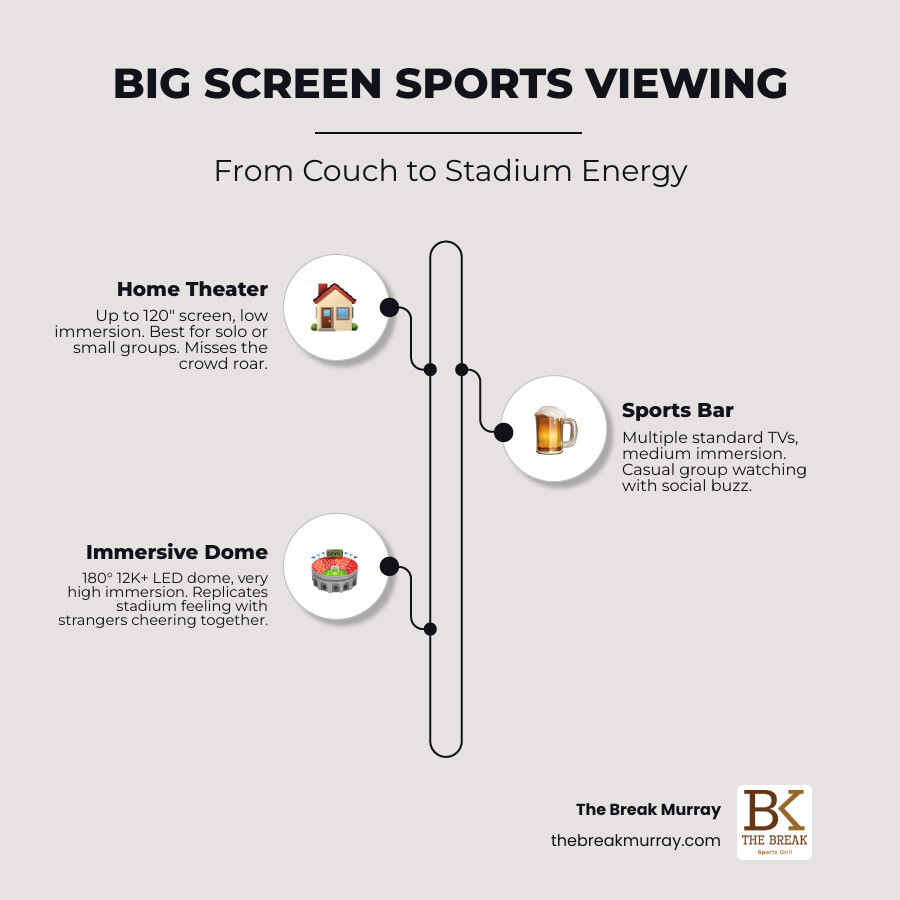
Quick look at big screen sports viewing:

For decades, out-of-home sports viewing fell into a few predictable categories. You had your traditional sports bars—dynamic, loud, filled with the smell of wings, and packed with dozens of flat-screen TVs showing different games. Then you had movie theaters, which offered massive projection screens but lacked the social freedom, ambient light, and interactive energy that sports fans crave. You certainly couldn’t yell at the referee in a quiet cinema without getting a few stern shushes.
Today, we are witnessing a massive evolutionary leap. The rise of “Shared Reality” venues is completely blurring the line between physical attendance and remote viewing. Unlike virtual reality (VR) or augmented reality (AR) which isolate users inside clunky, individual headsets, Shared Reality uses massive, specialized architectural displays to wrap the event around an entire crowd.
This design preserves the vital social and communal aspects of live sports. You can look your friend in the eye, clink glasses, and share a plate of nachos, all while feeling like you are sitting in a field-level VIP suite. It bridges the gap between the high-energy, community-driven vibe of a local pub and the absolute scale of a modern stadium. If you want to dive deeper into what makes a physical venue tick, check out The Sports Fans Guide to the Best Viewing Bars to see how local spots keep that crowd energy alive.
Shared Reality vs. IMAX: A New Era of Big Screen Sports Viewing
When people think of “giant screens,” IMAX is often the first name that comes to mind. However, the technology powering modern immersive domes like Cosm represents a completely different paradigm.
A traditional IMAX theater relies on a projected system that delivers a 70-degree field of view. While impressive for cinematic storytelling, you are still very much looking at a flat or slightly curved screen at the front of a dark room.
In contrast, next-generation immersive domes utilize a 180-degree, 12K+ LED dome display that completely engulfs your peripheral vision. Instead of projecting light onto a screen from behind the audience, these domes are made of millions of self-emitting microLEDs. This results in a mind-boggling 12K x 10K resolution with infinite contrast ratios.
To put that in perspective, while an IMAX screen makes you feel like you have the best seat in a movie theater, a Shared Reality dome makes you feel like you are standing directly on the pitch. You can look down to see the grass line or look up to watch the stadium roof. It is a technological cousin to the famous Sphere in Las Vegas, but scaled down and optimized specifically for live, real-time sports broadcasts. This breakthrough has caught the attention of major entertainment giants, leading to massive industry moves like Sony Pictures Entertainment’s $100M strategic investment in Cosm to help power this next era of entertainment.
To learn more about how these developments are shaking up the entertainment landscape, read about how a Massive LED dome offers new immersive entertainment in The Colony | Denton County | dentonrc.com .
Multi-Dimensional LED Walls and the Bellevue Experience
Domes aren’t the only way to create an immersive environment. Other cutting-edge venues are utilizing multi-dimensional, flat-panel LED arrays to wrap audiences in live action.
A prime example of this approach can be found at Mirra in Bellevue, Washington. Instead of a curved dome, this venue features a massive 1,750 sq. ft. LED wall system. This setup includes a 50×20 ft main wall, side wings, and integrated ceiling panels.
By running synchronized, high-resolution feeds across the front, sides, and ceiling, the venue creates a floor-to-ceiling viewing environment. When a goal is scored, the entire room erupts with visual effects that race across the walls and over the ceiling, mimicking the stadium’s lighting rig. It creates a 360-degree wrapping effect that keeps fans pinned to the action without the physical footprint of a massive dome.
If you want to see how this setup changes the game for international tournaments, check out how they host the Looking for the biggest World Cup watch party in Bellevue? Experience Eastside’s largest 8K screen wall at Mirra. .
Inside the Tech: What Powers These Next-Gen Displays?
To understand why these displays look so much better than a standard home television or projector, we have to look under the hood. The secret lies in microLED technology and advanced pixel architecture.
Standard home TVs and commercial projectors struggle in bright environments because they cannot produce enough light to compete with ambient room lighting. Projectors, in particular, wash out completely when the lights are turned on. Next-gen immersive displays solve this by using ultra-bright, self-emitting LED tiles.
Many of these high-end installations utilize a .78mm single encapsulated MIP (Micro LED in Package) architecture. By eliminating the secondary plastic protective layer found on standard commercial LED screens, these displays are virtually reflection-free, even in a fully lit room. This allows venues to keep the house lights up so fans can eat, drink, and socialize without losing a single ounce of image contrast.
On the ultra-premium end of private and commercial lounges, systems like the TITAN videowall showcase what is possible with state-of-the-art engineering. The TITAN features a massive 206-inch diagonal Cinemascope pane boasting 160% of native 4K resolution and an incredible contrast ratio of 30,000:1 or higher. This level of black-level precision and brightness creates an image so lifelike it feels like looking through a giant pane of glass.
For a deeper dive into the technical specifications of these high-end display systems, explore the MOON TITAN – GAMES- SPORTS – FILM & ATMOS MUSIC IMMERSIVE .78 MEGAMONITOR™ LOUNGE — IMMERSIVE WALLSCREEN CINEMAS BY THE INVENTOR OF THE VENUE CATEGORY .
To see how these top-tier technologies stack up against each other, take a look at the technical breakdown below:
| Feature / Spec | IMAX Theater (Projected) | Cosm Dome (LED) | Mirra Wall System (LED) | TITAN Videowall (MicroLED) |
|---|---|---|---|---|
| Display Technology | Laser Projection | 12K x 10K LED Dome | 8K Multi-Panel LED | .78mm MIP MicroLED |
| Field of View | ~70 Degrees | 180 Degrees | Multi-directional wrap | Flat Cinemascope |
| Contrast Ratio | ~2,500:1 | Infinite (LED-based) | High | ≥30,000:1 |
| Seating Style | Traditional Rows | Nightclub / Raked | Open Lounge | Custom Luxury Loungers |
| Ambient Light | Must be pitch black | Fully lit social spaces | Fully lit social spaces | Fully lit social spaces |
Protecting Massive Screens from Bass and Vibration
When you build a wall-sized screen made of thousands of tiny, delicate LED tiles, you run into a major engineering problem: vibration. Live sports venues are loud. Between screaming fans, high-output sound systems, and massive subwoofers pumping out low-frequency bass, the structural walls of a venue are constantly shaking.
Without proper protection, these vibrations can cause the seams between LED tiles to rub against each other, leading to pixel misalignment, physical damage, or outright screen failure. To prevent this, advanced venues use military-grade anti-vibration engineering.
First, the entire display framework is suspended using spring-loaded coil isolation mounts. These specialized mounts absorb roughly 75% of the mechanical vibration load coming from the building’s structure.
Second, acoustic engineers design a “planar bass wavefront” that is offset to peak exactly 1 meter in front of the videowall. This reduces direct acoustic coupling, keeping the intense air pressure waves from directly rattling the screen surface.
Finally, venues often implement a Double Bass Array (DBA) subwoofer configuration. By placing a matching array of subwoofers on the back wall that plays a delayed, phase-inverted signal, the venue can actively cancel out low-frequency reflections. This prevents modal buildup and standing waves from shaking the display, ensuring the picture remains perfectly sharp even when the bass is booming.
The Social Experience: Tickets, Spaces, and Stadium-Like Vibes
While the technology behind these screens is fascinating, the real magic of modern big screen sports viewing is the social atmosphere. Traditional movie theaters isolate you in the dark, demanding silence. Traditional stadiums offer incredible energy but put you at the mercy of the weather, long restroom lines, and expensive, cold stadium food.
Immersive venues bridge this gap by adopting raked, nightclub-style seating arranged around social tables and booths. Instead of staring straight ahead at a screen, you are seated in a dynamic, multi-tiered space designed for conversation.
These spaces feature integrated app-based food and drink ordering, delivering high-quality meals and cold beverages directly to your seat so you never miss a crucial play. Ticket prices are designed to be accessible, typically ranging from $20 for standard admission to $200 for premium VIP areas, depending on the event. It democratizes the luxury stadium suite experience, bringing it to everyday fans.
To see how you can upgrade your next game day with premium seating and social spaces right here in Utah, check out our guide on how to Upgrade Your Game Day with VIP Areas and Outdoor Sports Viewing.
Dome, Hall, and Deck: Tailoring the Big Screen Sports Viewing Experience
To cater to different moods and group sizes, next-gen venues are dividing their layouts into distinct zones. For example, a typical Cosm location features three primary spaces:
- The Dome: This is the heart of the venue—a fully immersive, multi-level theater featuring the 12K LED dome, raked social seating, and state-of-the-art spatial audio. It is designed for fans who want to feel completely lost in the game.
- The Hall: A vibrant, high-energy, multi-story sports bar space. It features massive, high-definition flat LED walls, a bustling bar, and a classic lively atmosphere. It is perfect for groups who want to socialize, eat great food, and keep an eye on multiple games at once.
- The Deck: An open-air outdoor terrace equipped with plenty of screens, comfortable seating, and great views. It offers a relaxed, casual environment to enjoy a sunny afternoon game.
This multi-zone approach ensures that whether you are looking for an intense, stadium-like experience or a relaxed afternoon with the family, there is a space tailored for you. If you are planning a family outing or want a spot that offers a mix of great views and activities, take a look at The Best Sports Bar with Patio and Arcade Games for Families.
When the autumn air hits, finding the right screen is crucial for football season. To make sure you have the perfect view of every touchdown, check out our curated list of Murrays Best Big Screens for Every Major NFL Matchup.
Strategic Locations and High-Demand Event Overflow
These massive, multi-million-dollar venues aren’t just built anywhere; they are strategically placed in major entertainment hubs. You’ll find them in places like Los Angeles (right next to SoFi Stadium), Dallas (within the massive Grandscape development), Atlanta, and Bellevue. These locations are chosen to capture the foot traffic of massive sports complexes and lifestyle centers.
One of their most important modern roles is serving as high-demand “overflow” venues. When massive events like the World Cup, the Olympics, or a sold-out Taylor Swift concert come to town, ticket prices for the live event skyrocket into the thousands of dollars—if they don’t sell out instantly.
Immersive venues act as the ultimate alternative. They allow thousands of local fans to gather together and experience the event live on a scale that feels incredibly close to being there, at a fraction of the cost. It turns a broadcast into a shared, city-wide event.
If you are looking for a fantastic place to catch these massive games locally without leaving the Salt Lake Valley, we have you covered. Explore our comprehensive playbook on Where to Catch the Game in Murray UT and Beyond to find the best local seats in the house.
Frequently Asked Questions About Immersive Sports Venues
How much do tickets cost for immersive dome experiences?
Ticket prices generally range from $20 to $200. General admission or basic seating for standard regular-season games sits on the lower end, while premium VIP booths, front-row dome seats, and high-demand events (like major UFC fights, playoff games, or concert broadcasts) command higher prices.
What is the difference between Shared Reality and virtual reality (VR)?
The biggest difference is the headset. VR requires you to wear a personal, isolating headset that cuts you off from the physical world. Shared Reality uses giant, wrap-around LED screens and spatial audio to build an immersive environment around you, allowing you to see, talk, and share the experience naturally with friends and other fans.
How do these venues handle high-demand event overflows?
These venues partner directly with major sports leagues (like the NFL, Premier League, and MLB) and entertainment companies to secure high-resolution, low-latency live feeds. Because they can accommodate large crowds in a stadium-like environment, they serve as official, licensed overflow destinations where fans can buy tickets to watch sold-out events together.
Conclusion: The Future of Communal Sports Entertainment
As we look to the future, it is clear that big screen sports viewing is no longer just about buying a slightly larger television for your living room. The human desire for connection, shared energy, and larger-than-life experiences is driving a massive shift toward premium, out-of-home entertainment. Whether it is a multi-million-dollar 12K LED dome in a major metropolitan hub or a beautifully designed multi-panel LED wall, these spaces prove that sports are always better when experienced together.
However, you don’t need to travel to Los Angeles or Dallas to get that incredible, high-energy communal feeling. At The Break Murray, we have built our entire experience around premium sports viewing, incredible food, and a welcoming community of local fans right here in the Salt Lake City area.
We feature top-tier, crystal-clear big screens, a newly remodeled vibe, and a lively atmosphere that keeps you right in the middle of the action. Plus, we pair our screens with fantastic food—if you want to know what to order for the big matchup, don’t miss The Ultimate Murray Guide to Nachos and Sports.
Skip the isolated living room couch this weekend. Bring your friends, grab a cold drink, and experience the game the way it was meant to be watched—surrounded by great energy and fantastic views.
Ready to secure your spot for the next big game? Visit us at The Break Murray and join the best sports community in Utah!